4 Reasons Why Your Problem-Solving Process Just Doesn’t Work

SpeedOrganizations today are facing more change than ever. That said, many leaders continue to try to solve organizational problems believing that what worked before will work again. The problem with this reasoning is that while it may seem intuitive, it is not supported by current global affairs. In fact, there are four characteristics of the world that continuously disrupt and destroy conventions.



  1. Dynamic: The world is in a constant state of change. This is nothing new–it’s been going on since the beginning of time. But what we’re seeing today is the growing rise of technology is creating changes that are rapid and disruptive. Five years ago it was the growth of the internet and social media, today we’re seeing a step-change into robotics and AI that will disrupt every industry. Leaders today need to have processes and tools to predict, manage, and navigate this continually changing landscape.
  2. Networked: The world is said to be growing smaller with the rise of social media. The real insight from social media is the realization that the world is networked, that decisions made in one context or industry or country can have ramifications for seemingly unrelated companies or industries. Did people really think that the iPod was going to take down the music and news media industries? Being aware of the networked world requires a different way of thinking and designing solutions. It requires dealing with parts in wholes and wholes in parts. It requires a way of working that is anticipatory and collaborative, not just linear.
  3. Open: The problems we are facing today are very much open-ended. When we are dealing with a world that is networked and in a state of rapid change, we realize that problems do not have clearly defined boundaries–they are not linear or fixed, but rather shift and emerge. This open system confounds the linear problem-solvers who try to rush to a solution which turns out to be a mere band-aid and not something truly transformative and authentic.
  4. Complex: A world that is rapidly changing, networked, and open is a complex world. Many CEOs complain that complexity is a big challenge in decision making. Complexity is driven, as with rapid change, by technology. How simple was it to receive a telegram? Today we receive information in at least four different ways: phone, text, email, and social media. Like the person I mentioned in one of my last posts who felt liberated when his iWatch broke, our technological world is making things more complicated rather than simpler. Complexity demands a very different way of problem-solving that is conventional. You can’t just get a few people in a board room and expect to reach a solution to a complex problem–it takes a different way of working.

This is where design comes in. As a process, design is itself dynamic, networked, open-ended, and complex enough to be requisite to the complexity of the problems of the day. Design doesn’t solve a problem but, at its best, creates the problem. Design is about forming networks of people and engaging in a way that leverages creativity and openness to reframe the problem in an entirely new way, then reach a rapid solution. Design is user-centric. Design is anticipatory.

Leaders today need to become more familiar with design and hire more designers. In a company in which there are more engineers and business-folk, designers are critical. If you do not have designers and creatives in your organization, chances are you’re just not that innovative, and may experience the threat of obsolescence in the near future.

The Real Wolves Of Wall Street… Sir Tim Berners-Lee & The Nightmare Scenario

wolf_wall_street2

Sir Tim Berners-Lee, the architect of the world wide web, has come out with a nightmare scenario about AI running companies that eat everyone else for lunch, thus becoming the new masters of the universe.

Speaking at the Innovate Finance Global Summit, Berners-Lee laid out a number of scenarios, such as “When AI starts to make decisions such as who gets a mortgage . . . . Or which companies to acquire and when AI starts creating its own companies, creating holding companies, generating new versions of itself to run these companies.”

The scenario is a simple one to understand and project: take a bunch of artificial intelligence that are already programmed in all the important areas of business management, and watch them self-improve beyond human intelligence. It’s like Terminator meets The Wolf of Wall Street.

Berners-Lee continues, “So you have survival of the fittest going on between these AI companies until you reach the point where you wonder if it becomes possible to understand how to ensure they are being fair, and how do you describe to a computer what that means anyway?”

Sir_Tim_Berners-Lee

To me, ensuring fairness is the least of our worries in such a scenario. What will humans be doing in these companies run by hyper-intelligent AI? Cleaning toilets? Well, there’ll be a bot for that. Making and serving coffee? Well, there’ll be bots for that. Running numbers, setting goals, creating spread sheets or project management deadlines? Nope.

It’s like Terminator meets The Wolf of Wall Street.

In such a world humans will indeed be on some kind of universal income. This is the post-human age: the age of human obsolescence in what we call these days ‘work’. Will work look different? Maybe. But the issue will be human potential and human self-worth. We can always try to ‘chip up’ but AI will advance faster than humans.

As humans we are created for work, we are created to be productive. You don’t have to look too far and wide to see the high rates of depression associated with unemployment. The nightmare scenario is not what will happen when robots start buying up businesses and cleaning the human race’s clock, but what will happen to millions of humans when they are on unemployment insurance.

Nevertheless, Berners-Lee is right on track with his scenario planning. Some people and companies are seeing the writing on the wall and making new plans and creating new businesses for the future. If you’re not doing this already, you might be too late. If you think this is all sci-fi dog-chow and not taking this seriously, you need to rethink your position. This is real. It’s happening, and we have very smart prescient people sounding alarm bells. Will we listen and innovate to new solutions, or fold our arms and go out with a whimper?

What The Light Phone, iWatch, and Jacques Ellul Have In Common

lightphone2

I remember when I first read Jacques Ellul’s The Technological Society–I was deeply disturbed by his conclusion that the world of technology (technique, as he called it) would run amok, that humanity could never return to pre-technological civilization, that technology would simply run its course and overtake humanity. Quite a predicament by a philosopher who wrote the book in the 1960s!

I haven’t thought about that book for a number of years, but it came to me today when I read an article in MIT Tech Review about the Light Phone: a simple phone that tells time and makes and receives phone calls–simple as that. To me, this is a wonderfully simple solution, but the writer of the review certainly didn’t think so.

lightphone1

The website describes the Light Phone as

a simple, second phone that uses your existing phone number. Leave your smartphone behind and enjoy peace of mind.

As a solution, the Light Phone reminds me of something I heard recently about the Apple iWatch. The iWatch is the antithesis of the Light Phone–to get data to your iWatch requires that you carry around your iPhone. To me this is too complex and gadgety. In our modern urbanized world, you shouldn’t have to take with you more devices than necessary. To wear something on your wrist that requires something else worn in your pocket to me is more of a capitalist ploy than a user-friendly solution.

apple.iwatch.1-640x427

Well, a couple of colleagues of mine have iWatches–and they love them. They are always the ones at lunches and dinners providing fee demos about the phone’s various functions, which I must add are quite convincing. If I had a thousand bucks burning a hole in my pocket I probably would have bought one already. But the more I hear about the iWatch, the more I am learning about it as a kind of hand-cuff rather than wearable solution. I know one person who came very close to purchasing one but too was held back by the price tag. One day he met up with a colleague who had one that broke.

“Did you enjoy having it?” he asked.

“Oh absolutely–I loved it!”

“So are you going to buy another one then?”

“No.”

“Why not? I thought you just said it was the best thing you had?”

“It was–until I didn’t have it around my wrist. When I had the watch on, I loved the functionality, I couldn’t get enough of it . . .”

“So then what happened?”

“When I could no longer wear it, I felt free! Free from that stupid thing! For whenever I wore the watch, I was looking at my wrist every 3 seconds, all day long! ‘Bling!’ check my wrist. ‘Bling!’ check my wrist. I’m telling you–I feel liberated without that stupid watch!”

But do people feel free when they lose or break their technology? Could you disconnect from your smartphone and/or watch for a day and feel cool about it? Is the Light Phone a fantasy, a utopia, or a serious solution for the 21st Century?

The individual is in a dilemma: either he decides to safeguard his freedom of choice, chooses to use traditional, personal, moral, or empirical means, thereby entering into competition with a power against which there is no efficacious defense and before which he must suffer defeat; or he decides to accept technical necessity, in which case he will himself be the victor, but only by submitting irreparably to technical slavery. In effect he has no freedom of choice.
Jacques Ellul, The Technological Society

This leaves us pondering Jacques Ellul. Technology keeps running amok, and there’s nothing we can do about it. Even when given a choice to have or not have it, we can’t live without it.

jacques ellul
Jacques Ellul predicted the Technological Society would run amok functioning without human intervention.

To me, the Light Phone is a fantasy, a product fetish. It points backward to a time when human life was perhaps simple. It is a fantasy of regress, rather than a solution of progress.

Would I choose a Light Phone? Maybe in another time and place. I like simplicity. I like to think of myself as a simple guy. But I live in a world that demands my time, demands that I am immediately updated and responsive to the information coming at me 24/7. I would like to choose a different life, but that would require that I change what I do. It would require that I enter a simpler life. Perhaps the Light Phone is a symbol of that simpler life, of that utopia (and by the way, ‘utopia’ means ‘no place).

So while I judged the MIT Review columnist for her disdain for the Light Phone, I had three fingers pointing back at me.


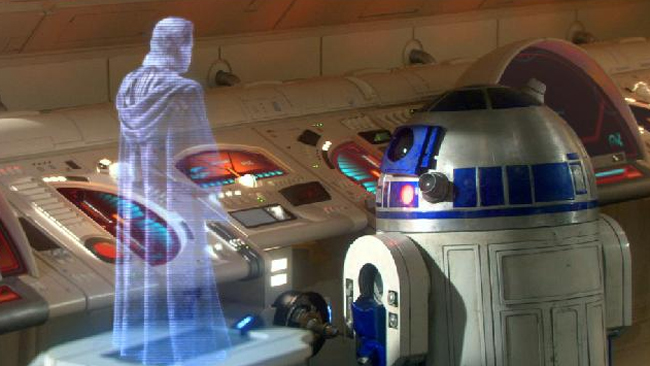
Holoportation Is The Doorway Into A New World–Seriously.

starwars
Are we becoming less human? 
Sounds like a silly question, but when you look at how technology is developing, the kinds of things being developed, and where it all seems to be going, you get the sense that being human is on the road to obsolescence–without Elon Musk telling us it is so.

One striking example of this is “holoportation”–a terms Microsoft has created for its new hologram solution. As Wired describes,

Holoportation, as the name implies, projects a live hologram of a person into another room, where they can interact with whomever’s present in real time as though they were actually there.

And what inspired holoportation? The amount of time researchers had away from family, and the desire to reach out to them in a more effective way than merely Skype or FaceTime: “We have two young children,” said Izadi, one of the key researchers of the program, “and there was really this sense of not really being able to communicate as effectively as we would have liked,” Izadi says. “Tools such as video conferencing, phone calls, are just not engaging enough for young children. It’s just not the same as physically being there.” The way Microsoft has developed holoportation is to rig up a room with sophisticated 3D cameras that take images of every angle of the individual and the space he or she is in. Once all the images are captured, the custom software stitches them together into a full 3D image. 

Holoportation
Microsoft Holoportation Demo. Can you believe this stuff?!

But get this: to make the technology ubiquitous, Microsoft claimed all one would need is a VR headset. To accomplish this vision, Microsoft has hooked up with Intel to share their knowledge of how to build virtual reality headsets with other VR companies–a way to make this technology ubiquitous. And according to Ray Kurzweil, VR is key to immortality–yes immortality. Through holoportation, one can see how humans will transport themselves all over the world and even to other worlds.

 But there is certainly a difference between encountering a physical person and a hologram. I suppose one could see a technology developed that would trigger sensations in the brain to give one the feeling of being with a physical person while in virtual reality. But, again, is being with a physical person a difference that makes a difference for intimacy and overall human relationship? Is a holographic conversation with my child the same as actually being in the room with him? Is there something important about human connection?  What about when I am sad or hurting? Can a hologram really console me?

This will become ubiquitous, and it will become embedded technology–by that I mean in the brain. This is a doorway to a new world, and we need to be aware of its unintended consequences.

It also presents tremendous opportunity for businesses to design solutions for VR, from business to education. This is the future, and it will very quickly become the present.

10 Ways To Become A Designer

design

We need designers now more than ever. And, the world is being designed now more than ever. Take a simple example: When you drink a bottle of water, you are supporting a design practice of water extraction, bottling, business model design, product design, marketing, and even environment design by virtue of putting more demand on the production of plastic products. Take our ingestion of graphic images, also products of design, and our production of graphic images–how many photos do you upload to a social network? This act of blogging is contributing to the world of design.

What this does is makes designers of all of us. To ‘design’ means to ‘mark out’–to put a stamp on the world. But this way of designing based on the innumerable actions you take on a daily basis is a more tacit form of design.

So how do you become a designer? Here are a few tips:

  1. Think Solution: Designers love to solve problems. We love to look at the world as it should be not how it is. And when we find problems, or things that just don’t look or function well, we think about ways to solve them. Designers are concerned about how designed things are being used, and whether or not they can be designed better to be used better. A designer wants to make the world a more beautiful, well functioning place. This also relates to organizational change. We see organizations stuck in ruts or approaching obsolescence and we want to provide solutions.
  2. Think Iteration: A solution doesn’t just happen first step out of the gates. Design is an iterative process, meaning that it takes multiple tries (and fails) over time. So many people are afraid of failing that they won’t even try to make the first sketch–or first line. However, when you think iteratively, the pressure’s off: if the first try doesn’t work, you just keep trying. Thomas Edison’s famous statement is apropos: “I did not fail,” said Edison about the lightbulb, “I just found 10,000 ways that did not work.”
  3. Think Systems: Designers often see parts in wholes and wholes in parts. We often try to understand the system we’re in, and how it all works (or doesn’t work), as part of the design process. If we see a problem, we wonder what system constraints are causing it. And when we design solutions, we look for ways the surrounding system will be impacted by it. Being a systems thinker is important for being a good designer.
  4. Think Vision: Designers do not work from here to there, as manufacturers do. Instead, we work from there to here: we begin not with the current state of things, but with a better future that we envision. Then, our design process is a way of pulling the future into the here and now one iteration at a time. Great designers are great visionaries.
  5. Think Different: Designers love to live outside the conventions and norms of a system or society. They are often misfits who love to play in the world of ideas. To be a designer means you’re constantly pushing your ideas outside of convention. You’re always stretching your ideas to see a better solution.
  6. Think Simple: Yes, we talk about systems and complexity, but design should be simple. Some people claim you need more complexity when designing for a complex system, but I disagree: the best design is simple and intuitive. Think Helvetica as a typeface–so lucid, so simple, like air. Or consider Massimo Vignelli’s famous design of the map of the New York Subway. Good design is simple design–it is as little design as possible.
  7. Think Learning: Designers are constantly learning new things. Obviously, most people are learning; but to a designer, as one who loves to play in the world of ideas and unlimited possibilities, learning is critical. If you simply look up all the numerous design processes and principles alone, you could spent many years learning how to apply them. You have to always be learning new things that will give you a better vantage point on a particular problem or give you better tools for a solution.
  8. Think Risk: If you’re afraid of risking, but want to become a designer, then you need to build up your courage. Designers have to take risks. Imagine this: you are going to pitch a major company a new idea, something they’ve never thought of before. You are putting your neck on the line–what if the client rejects it? But that is the discipline. You have to be prepared to push the boundaries of convention and create things that people perhaps have never seen before or thought of before. But that’s the beauty of good design.
  9. Think Documentation: A good designer documents–through photos, video, note taking and journaling. Documentation is how you keep track of ideas. Some swear by Evernote or other tools. Some don’t leave home without their pocket Moleskine and Lamy Safari. Regardless of your style, you have to document your ideas. One simple way is to carry a pocket notebook around in which you jot your ideas down as they strike your mind.
  10. Think Research: Designers are always researching new trends and ideas. Apart from learning, research is important for observing the world of the future, the world of tomorrow, not just today. A good designer has one foot in the future and another in the present. And thus research is a critical activity for the designer. It is also important to research broadly and across disciplines–you never know how two or more ideas will converge.

These are some of the basics for becoming a designer. The good thing about our world today is there are many designers, they’re in high demand, and the world needs more of them.

7 Striking Reasons Why Your Organization Needs More Designers

designers

There is a surging demand for designers, particularly in Silicon Valley. More Fortune 500 companies are buying design firms than ever before. And designers are being hired by venture capital firms not to design logos, but to take part in the process of finding the best investments.

Why are designers so important? Why should you, if you’re a manager or entrepreneur or business owner seek to hire more designers? Here are a few reasons:

  1. Vision: Design is a process of having a vision for something that doesn’t yet exist and pulling it into reality. Designers have an amazing ability to see new ideas and try them out. Companies today need designers as a response to the world of rapid change and complexity. Organizations today need people who are able to see new ways of doing things, new concepts, new realities, and then be bold enough to try them out.
  2. Iterative: Design is an iterative process. It doesn’t seek to get the solution right the first time, rather it is a process of trying, failing, failing again until the solution emerges. Designers are trained to create a hundred thumbnail sketches for a single concept in only an hour. Their ability to create a concept, scratch it out and create a better one is important in a competitive marketplace that demands a perpetual stream of new ideas and solutions.
  3. Creativity: Designers have an amazing way to think outside the conventional. Whereas engineers like to work in structures, designers will often deconstruct restraining forces before coming to a solution. And contrary to builders who just need the drawings to build, designers know that for the drawings to be inspiring and lead to a user-friendly solution, there needs to be a process of play and trial and error.
  4. Not afraid to fail: Designers are used to failing all the time–it’s part of the iterative process of the work. A designer can recreate and recreate and recreate again. If something doesn’t work and a designer’s work is criticized, no problem: the designer will either keep iterating, or flat-out reject the criticism and continue on. Where ideas and solutions are demanded, you need people with thick creative skin who aren’t afraid to come out of left field and be critiqued for it.
  5. User Experience: Designers are all about user experience and finding solutions to problems. A designer seeks to make a current experience better, easier, more fluid, or to create something new to meet a particular demand. The iPhone came out of Steve Jobs’ disgust at how poor the user experience was for his mobile phone. People want products that respect them; that make it easy for them to use. Designers know how to do this.
  6. The world is designed: The modern world contains more human design than any other time in history. In fact, design makes designers of us all. To design means ‘to mark out’, which makes designers of all of us (Drink a bottled water to see what I mean). And because of this, you need people who understand the language of design and how to create things that stand out from the rest of the designed world.
  7. Integrators: Design is often an integrative art. A good designer can integrate a variety of styles and solutions and concepts into a single solution. Take Frank Lloyd Wright’s architecture: it was often a fusion of different styles and cultural expressions (Japan meets Bauhaus), but that’s what made his houses so rich and textured. In a fragmented world, you need designers who can integrate seemingly disconnected ideas and frameworks into an integrated whole.

5 Triggers Of Group Innovation

Group-of-Multiethnic-Busy-People

Creativity is for everyone. You can do it, I can do it. That’s because we’ve all been created to create. It’s like we have a creative gene that is essential to being human.

That said, we can create situations and surroundings that quell or diminish or hinder our creativity. And, conversely, we can create situations and surroundings that foster it–that literally enhance our levels of creative performance.

If you do something over and over again, it will become a habit. Creativity is the same thing–this is why writers will write everyday, painters will paint everyday, the business executive will work 80 hour weeks. What people are doing is building neural connections in the brain that will wire together and thus form a habit. Have you ever seen Picasso sit down and just start painting something awesome? He truly mastered his medium. It’s said that it takes 10,000 hours to become a master at something. That’s because it takes that many times for your brain to create the neuronal connections. Now Steven Kotler, on whose 17 triggers of innovation this post is based, maintains that by mastering how to create flow states, that 10,000 hours can be cut in half. That could very well be.

What these habits do is create the conditions for a thing called flow. Steven Kotler, based on the seminal work by Mihaly Csikszentmihalyi, defines flow as an optimal state of consciousness in which we both feel and perform at our best.

Here are 5 habits that enhance creativity:

  1. Intense Focus: Aldous Huxley was known for answering the door of his house, having a conversation with the person, and then forgetting who it was when his wife later queried him about it. The famous writer G.K. Chesterton was known for calling his wife to tell her he’s at the train station, and to ask where he is supposed to be going. “Home dear!” she would reply. Intense focus is critical for creativity and innovation. It requires a single activity and solitude. You’ve got to shut off your phone, lock yourself in a room for days on end, and be alone. This is how many great writers and scientists and painters and musicians have created over the centuries.
  2. Clear Goals: This is important. ‘A goal without a plan is just a wish’. This also relates to the goal itself. If you have no objective, you will have no direction. It could be the case that following the goal will take you into a different direction, but you still need to start with a goal. In group innovation, having a clear goal that is agreed upon is critical for solving that complex challenge.
  3. Immediate Feedback: If you’re painting, and the colours don’t work or the strokes are too thin or the line you just wrote sounded terrible, you have immediate feedback. But what about that project for your director you’re working on? You need to get immediate feedback. This requires vulnerability. If I’m doing work for someone, I like to ship multiple iterations–I don’t care how good they are. I’m just trying to get new ideas out and get feedback on them.
  4. Challenge/Skills Ratio: To be in the sweet spot of creativity and innovation you need be in the tension of a serious challenge that is almost beyond your ability to solve it, and you need to have the requisite skills to solve it. An artist will immediately see when he or she is pushing the boundaries of skill when venturing out on a work and thus might pare it down. You want to hit the mid-way mark between performance and anxiety. The challenge must be slightly greater than the skills we bring to it.
  5. High Stakes: To be in flow we need to be working on projects that matter. We need to be taking a risk at something. I resonate with Richard Branson who claimed that if it isn’t fun and challenging he won’t do it. There is a time for playing it safe, but not in creation and innovation. And in groups, you need everyone on board with the risk, willing to stick their necks out to succeed. There has to be skin in the game.

These are just 5 habits of creativity and innovation. They will work with individual and group creativity. These become habits when one puts time into each of them, allowing them to become part of one’s daily practice.

In future posts, I will continue with more habits. Meantime, try these out and see how they work for you. Add a comment if you like what you’ve read.

8 Common Mistakes That Will Destroy Innovation In Your Organization.

strategy_0016_disruptive_innovation

Our world is a very complex one. The problems we have today require new ways of thinking and collaborating.

A problem is that while technological development is demanding new institutional structures and ways of working, the institutions themselves are often stuck in old patterns of thinking and working.

Many people are apprehensive of new structures and patterns for fear of failure, which sets up a seeming dilemma: on the one hand, many organizations are being forced to change in response to disruptions in the marketplace, and yet on the other there is a fear of changing those very structures that brought the company success in the past.

Here are some more common mistakes that will totally destroy innovation in your organization:

1. Old thinking: When seeking innovation, it’s important to think in new ways, to think about new things, and to think in divergent ways. For example, if you’re trying to think about a business solution, think outside business: look at breakthroughs in science, or other areas of research–that conflict of thinking will force your brain to process in a different way, thus shocking it into a new idea.

2. Stale environments: One of the most depressing things I have to face as a business consultant is the dreadful boardroom: the conventional polygonal table, rolling chairs, fluorescent lighting, suits, ties, and vinyl portfolios replete with cheap conference ballpoint pens–boring! You need a completely different environment; one that fosters lots of movement, fun–yes fun!–drawing, sketching, researching large picture books and articles and magazines, food–lots of good energy food–, oxygen from plants, music–yes, music during a meeting!–and natural light. Just by doing this one thing differently, your meetings will generate totally different results.

3. Cynicism and Black Hats: If you have complainers, and you’re trying to get new ideas, leave them out of the meeting until you’ve got some big ideas marked out and you need people to kick the can–then bring them in. Winers, complainers, black-hat doffers are brutal when you need innovation. Think of your ideas as seedlings–the last thing you need is someone clumsily stomping over them when the poor things have hardly had a breath of air.

4. Conformity, Complacency, Compliance: Workplaces are tribes: they have culture, belief systems, and policies that keep everyone in check. The problem is that people not only dress the same (whether the same blue suits and ties, or checkered shirts from Banana Republic), but also talk and think the same. This is thought of as successful cultural development–but it can totally destroy innovation. You want alignment around the vision of the company, but not about the ideas that will bring it to fruition. You need misfits, rebels, artists, outcasts–people who are committed to the organization, but not interested in conforming to cultural expectations that mean little to the bottom line.

5. Alignment too early: This is a killer of innovation, because it typically comes a) out of pressure to please the CEO, or b) out of laziness to come to a solution before it’s time. Innovation can take a long time, and it often requires a lot of oscillation and conflict for a new idea to emerge. Typically, organizations will jump to the first idea or solution that comes up, not realizing they haven’t scratched the surface of the problem their facing and what a solution would even look like.

6. Relevance: Those who try to innovate while keeping every idea ‘on topic’ to the problem at hand or to the current structure of the organization often fail. The whole point of innovation is to create something new, and, when it’s at its best, disruptive. And to do that, you’ve got to turn over all kinds of stones, and over turn innumerable boxes–and it’s not always going to look relevant. Those companies really good at innovation are working on solutions decades in advance, and unrelated to the current direction of the company.

7. Conventional structures: Innovation is a disruptive activity–its very purpose is to up-end the status quo and create something new. And yet, many organizations believe they can innovate by calling more meetings or having more brainstorming sessions (whatever that means), while keeping their organizations structured the same. Do you have a full-time R&D department? Do you have a full-time Innovation Department? Do you have people working on stuff that is totally outside of your current issues? Do you have people researching the future, reading Wired Magazine, and taking routine field trips to massive research libraries and zoos and museums and art galleries and hanging out at trendy cafes? If not, you need to rethink.

8. Lack of structure: To become innovative, Whirlpool needed to put a series of structures around how innovation would be done by everyone everywhere. This took years to work through and fully understand–but they took the time, and built the structures and practices necessary for it to take place. Innovation is a set of beliefs, it has a cultural expression, and it ought to have policies in place to help it flourish. Innovation is a kind of art; and any artist will tell you that creativity doesn’t just happen without structure and routine in place. If you want innovation, you have to go through a process of building it into your organization.

These are only a handful of innovation killers–there are many others. If you’re new to all of this, there’s a wealth of information out there. Some of it’s good, some of it’s not–the whole thing takes time and a fair bit of trial and error. The key is if you’re leading a company, or starting one, you’ve got to take this innovation thing very seriously–you’ve got to make sure you have structures in place to do it.

Drinking Coffee And Other Triggers Of Great Ideas.

balzac-on-coffee

Having good ideas is important, whether you’re an entrepreneur, manager, artists, student, or just trying to manage your life. There is a history around the word ‘idea’, but I won’t go into that here. What we commonly refer to when we talk about ideas is a certain kind of thought that occurs in the mind as a result of our experiences–phrases like ‘flashes of insight’ or ‘eureka moments’ seek to pinpoint what ideas are.

There are countless books written about ideas. Steven Johnson’s Where Good Ideas Come From will give you plenty of insight–at least it has for me. As a researcher, consultant, and writer, I’m always looking for good ideas, but even as Johnson maintains, it’s not always easy. Here are a few tips:

1. Drink coffee: You don’t like coffee? It doesn’t matter–drink it. According to Johnson, the Enlightenment was spawned by the rise of coffee consumption and the cafes; in fact, cafes, rather than pubs, became the breeding ground for the surge of intellectualism that period boasts. Does this imply that you won’t get good ideas if you’re a tea drinker, or don’t consume caffeinated drinks at all? Of course not. But coffee is known to dramatically stimulate the brain, spawning new ideas.

2. Write it down–capture it! If you’re after good ideas you can’t afford to go through life on autopilot. You need to capture your experiences, thoughts, reflections, brain waves. If you haven’t done this before, go and get yourself a notebook and play journalist for the day: write down what you see, conversations you hear, and your reflections on them–you won’t believe it. This is one of the oldest and most effective ways of getting good ideas–it’s no wonder that the acclaimed notebook company Moleskine was inspired by the notebooks of Hemingway, Picasso, and Van Gogh. I’m surprised by how many people do not practice this simple way of recording one’s life. Try it.

3. Walk around: The flaneur was a French phenomenon in the 19th Century embodied by the painter or writer or philosopher who would wander through the streets of Paris experiencing the world and…feeding his or her ideas. Did the flaneur have a particular place to go? No. Was the point of the walk to merely wander around? Yes. There is a rich history of the flaneur. How does it work? Simple. You’re working through an idea or problem, and thus your mind is attuned to it. But your idea or solution needs some diversity to pull all the pieces together into something rich and original and salient. You take a walk through the mall or along the streets and everything you witness jumps out at you and congeals with the problems your mind is working on–and whammo! The new idea or insight emerges. But you have to make sure you have your notebook handy to write it all down. If you want to see an entertaining movie about the flaneur, see Woody Allen’s Midnight in Paris.

4. Give yourself time: Yes I know your boss is seriously pressing you for a new idea, or you’re a boss and you need a big idea for the next quarter, or you’re a student pressed for time on a research paper due tomorrow morning–but…you need to give yourself time. Ideas don’t just pop out of nowhere; and they can’t be rushed. Some ideas take decades to come to fruition. Think of the poet Bukowski who compared a poem–an idea–to a spider that he watches quietly crawling down the wall: it takes its time; it crawls a few steps down, then scurries back up. Do you have the patience to wait for it? Steven Johnson in Where Good Ideas Come From calls this “the slow hunch” contrasted with the often-used but rarely experienced “Eureka moment.” The slow hunch is the problem you walk around with for a long time; the one that requires a ton of experience to germinate; the one that is in need of other sources of knowledge and information and a diversity of practice to really emerge. It takes time.

5. Diversity of information: If you have a business problem, go to the museum. If you have a science problem, go to the mall and tinker around at the Apple Store. If you are researching for a social science paper, or working on engineering a new technology, go to a butterfly conservatory, or the symphony, or wander through the forest. You see, you need to get diverse, not monolithic. Your brain needs stimulation from other sources to put the pieces together–as mentioned above. If you’re working on a design problem, read about bees. Dive into the Encyclopedia Britannica and read all kinds of random articles. Do anything you can to get diversity. Johnson calls this “serendipity”: when ideas bounce around into other ideas and voila–a new insight.

There are many other ways to get new ideas, but these five are a good place to start. My go-to is the notebook–I take mine everywhere. It’s a slim one that slips into my jeans pocket, and in which I mark down as much as I can; a lot of it’s nonsense, but there are a few flecks of gold dust in there somewhere. Also, read everything. If you’re not a reader, become one. Read biographies, especially of creative people: how did they work, what were their habits? Read read read. Then jot down your thoughts in your notebook. Sounds simple? At least that part of it is.

IBM’s 5 Predictions For 2022 That Will Change Everything

minority-report

IBM released a set of 5 predictions for 2022. Here they are, along with some different perspectives for understanding and interpreting them for your venture or enterprise.

A ‘Slice’ of Reality

A quick word about predictions. Are they true? We of course don’t know. A prediction is simply a mental model, or ‘slice’ of reality. We do not know the future, but we can build models of it to help us understand not only what is ‘not yet’, but how what is happening now could emerge and impact us. IBM has made these 5 predictions based on what it knows now; but each of these predictions have the potential to emerge earlier–or later, of course–and in a more vibrant or different way than predicted.

Opportunities and Threats

Each of these predictions will have further ramifications on the social, political, and existential dimensions of human life. We are often attracted to technological advancements because we envisage them as a panacea for the ills of life. However, there is no evidence that such a belief is true. As we read predictions we must look at both the opportunities and threats that each one presents and poses. If you’re reading a trend that presents a positive view, ask yourself about the threats.

Unintended Consequences

“The road to hell is paved with good intentions.” This is a cliche, but as the case with cliches there is some truth to it–especially with technology and design. We can design something for good, unaware of the potential it has for emerging into something detrimental. “A pessimist sees an threat in every opportunity. An optimists sees an opportunity in every threat.” To design something with the unintended consequences in mind is critical in our world of change and complexity. As you’re reading these trends, look at them from both the optimistic and pessimistic point of view. Ask yourself about the unintended consequences that could arise from each technology.

IBM Predictions for 2022

1. AI Gives Window Into Mental Health Through What We Write:

The written word is nuanced–there’s language between the language between the language. What we write and how we write it can provide a window into our psyche. However, not everyone is able to read between the lines–but an AI certainly can. With the rise of data and how it is being compiled and used in various applications, an AI will be able to detect mental illness in the information it receives from human interaction. IBM predicts that in five years, “What we say and write will be used as indicators of our mental health and physical wellbeing.” There will be ‘applications’–they won’t be called that, but that’s beside the point–that will be able to detect early signs of various cognitive disorders, mental illness, and other ailments. According to IBM’s Study, one in five adults in the U.S. experiences a mental health condition such as depression, bipolar disease or schizophrenia, and roughly half of individuals with severe psychiatric disorders receive no treatment. The global cost of mental health conditions is projected to surge to US$ 6.0 trillion by 2030.”

2.Super Hero Vision

Our eyes have limits. Technology has enhanced those limits for hundreds of years. With AI, enhancement is amplified by an order of magnitude. Hyper imaging will help us see beyond visible light to see into the electromagnetic spectrum that will open to us a whole other realm of perception.

Currently we can see into the electromagnetic spectrum through machines. These simple machines help us see tooth cavities and decay or check bags at an airport. These machines are simple and expensive.

In the near future with the advent of AI, these machines will become better and cheaper. We will see into reality in a completely different way, such as allowing a car to see through fog or enhanced night vision. It’s like we will be given the perpetual power to see through walls.

When implanted in a phone, or embedded chip in your brain, you’ll be able to see into the nutritional components of food. Imagine what it will do to research in sciences! We will be given the tools for perception far beyond what we have the ability for now.

What will this new technology provide? Well, greater vision. But what about the unintended consequences. Here’s a simple one: what is concealment in an electromagnetic society? Anyone will be able to see what you are carrying in your bag or your coat pockets. It’s simple and crude, and there are much greater unintended consequences, but we have to understand the risks this technology will create.

3. Microscopes–How About Macroscopes?

We are able to see detail at the micro-level. We can also see some detail far away with telescopes. But what about macroscopes? Here’s IBM:

[A macroscope] will organize the information about the physical world to help bring the vast and complex data gathered by billions of devices within the range of our vision and understanding. [Unlike] the microscope to see the very small, or the telescope that can see far away, it is a system of software and algorithms to bring all of Earth’s complex data together to analyze it by space and time for meaning.

This macroscope will be connected to all the billions of sensors in IoT to present BIG data in ways we have not seen before. This will be a hyper-bird’s eye view into the world of information. According to IBM, it is working on digitizing the entire world.

Think about that! With such information what will you be able to create? What will you be able to learn? It’s extraordinary. But there is always an underbelly.

What risks does this technology pose? What will you NOT be able to design? Where will this information go? What if it goes into the wrong hands? What will this information do to threaten personal and national security? What will you have to give up for this information to be available? How will this technology impact your company? This data will aid in water irrigation, farming, and other industries.

4. Medical Labs on Chips Will Trace Disease on Nanoscale

This technology has been predicted by Ray Kurzweil for many years–nevertheless, it’s shocking to see that it will be available in only 5 years from now. The key is to shrink down to a single chip all the technology necessary to diagnose a particular disease. Where this will lead is to nano technology that will enter the body and provide treatment. It could also be combined with genetic technology that will remove the genes causing the disease in the first place.

What will such technology do for human longevity. We already have people being born today that, apart from a global catastrophe such as a nuclear disaster, will live until 300-400 years old. When we can quickly diagnose, and on a genetic level remove disease, we will be closer to living for hundreds of years.

Think about this on a social and economic scale? What will work look like when people are living for so long? What will social services, geriatric care, seniors’ living look like? What are the opportunities and threats for this scenario?

5. Smart sensors will predict environmental pollution at the speed of light

These tiny sensors will be able to predict gas leaks in real time. This would be around natural gas extraction wells, pipelines, and around storage facilities.

Networks of IoT sensors wirelessly connected to the cloud will provide continuous monitoring of the vast natural gas infrastructure, allowing leaks to be found in a matter of minutes instead of weeks, reducing pollution and waste and the likelihood of catastrophic events.

This may not sound like a big deal, but what else could these smart sensors predict? What about nuclear leaks? There are also so many natural disasters taking place from floods to tsunamis. Could these smart sensors be used to predict those calamities as well.

These are just five predictions. The point is not to camp directly on these, but to use them to build models with about the future. How will your business enterprise, your city, your educational institution be impacted by these predictions if they were to take place?

And, how could you stretch those predictions into scenarios that can be used to plan your next venture or enterprise? This is where you can turn simple information into a valuable and critical tool.