4 Reasons Why Your Problem-Solving Process Just Doesn’t Work

SpeedOrganizations today are facing more change than ever. That said, many leaders continue to try to solve organizational problems believing that what worked before will work again. The problem with this reasoning is that while it may seem intuitive, it is not supported by current global affairs. In fact, there are four characteristics of the world that continuously disrupt and destroy conventions.

  1. Dynamic: The world is in a constant state of change. This is nothing new–it’s been going on since the beginning of time. But what we’re seeing today is the growing rise of technology is creating changes that are rapid and disruptive. Five years ago it was the growth of the internet and social media, today we’re seeing a step-change into robotics and AI that will disrupt every industry. Leaders today need to have processes and tools to predict, manage, and navigate this continually changing landscape.
  2. Networked: The world is said to be growing smaller with the rise of social media. The real insight from social media is the realization that the world is networked, that decisions made in one context or industry or country can have ramifications for seemingly unrelated companies or industries. Did people really think that the iPod was going to take down the music and news media industries? Being aware of the networked world requires a different way of thinking and designing solutions. It requires dealing with parts in wholes and wholes in parts. It requires a way of working that is anticipatory and collaborative, not just linear.
  3. Open: The problems we are facing today are very much open-ended. When we are dealing with a world that is networked and in a state of rapid change, we realize that problems do not have clearly defined boundaries–they are not linear or fixed, but rather shift and emerge. This open system confounds the linear problem-solvers who try to rush to a solution which turns out to be a mere band-aid and not something truly transformative and authentic.
  4. Complex: A world that is rapidly changing, networked, and open is a complex world. Many CEOs complain that complexity is a big challenge in decision making. Complexity is driven, as with rapid change, by technology. How simple was it to receive a telegram? Today we receive information in at least four different ways: phone, text, email, and social media. Like the person I mentioned in one of my last posts who felt liberated when his iWatch broke, our technological world is making things more complicated rather than simpler. Complexity demands a very different way of problem-solving that is conventional. You can’t just get a few people in a board room and expect to reach a solution to a complex problem–it takes a different way of working.

This is where design comes in. As a process, design is itself dynamic, networked, open-ended, and complex enough to be requisite to the complexity of the problems of the day. Design doesn’t solve a problem but, at its best, creates the problem. Design is about forming networks of people and engaging in a way that leverages creativity and openness to reframe the problem in an entirely new way, then reach a rapid solution. Design is user-centric. Design is anticipatory.

Leaders today need to become more familiar with design and hire more designers. In a company in which there are more engineers and business-folk, designers are critical. If you do not have designers and creatives in your organization, chances are you’re just not that innovative, and may experience the threat of obsolescence in the near future.


The Real Wolves Of Wall Street… Sir Tim Berners-Lee & The Nightmare Scenario

wolf_wall_street2

Sir Tim Berners-Lee, the architect of the world wide web, has come out with a nightmare scenario about AI running companies that eat everyone else for lunch, thus becoming the new masters of the universe.

Speaking at the Innovate Finance Global Summit, Berners-Lee laid out a number of scenarios, such as “When AI starts to make decisions such as who gets a mortgage . . . . Or which companies to acquire and when AI starts creating its own companies, creating holding companies, generating new versions of itself to run these companies.”

The scenario is a simple one to understand and project: take a bunch of artificial intelligence that are already programmed in all the important areas of business management, and watch them self-improve beyond human intelligence. It’s like Terminator meets The Wolf of Wall Street.

Berners-Lee continues, “So you have survival of the fittest going on between these AI companies until you reach the point where you wonder if it becomes possible to understand how to ensure they are being fair, and how do you describe to a computer what that means anyway?”

Sir_Tim_Berners-Lee

To me, ensuring fairness is the least of our worries in such a scenario. What will humans be doing in these companies run by hyper-intelligent AI? Cleaning toilets? Well, there’ll be a bot for that. Making and serving coffee? Well, there’ll be bots for that. Running numbers, setting goals, creating spread sheets or project management deadlines? Nope.

It’s like Terminator meets The Wolf of Wall Street.

In such a world humans will indeed be on some kind of universal income. This is the post-human age: the age of human obsolescence in what we call these days ‘work’. Will work look different? Maybe. But the issue will be human potential and human self-worth. We can always try to ‘chip up’ but AI will advance faster than humans.

As humans we are created for work, we are created to be productive. You don’t have to look too far and wide to see the high rates of depression associated with unemployment. The nightmare scenario is not what will happen when robots start buying up businesses and cleaning the human race’s clock, but what will happen to millions of humans when they are on unemployment insurance.

Nevertheless, Berners-Lee is right on track with his scenario planning. Some people and companies are seeing the writing on the wall and making new plans and creating new businesses for the future. If you’re not doing this already, you might be too late. If you think this is all sci-fi dog-chow and not taking this seriously, you need to rethink your position. This is real. It’s happening, and we have very smart prescient people sounding alarm bells. Will we listen and innovate to new solutions, or fold our arms and go out with a whimper?

What The Light Phone, iWatch, and Jacques Ellul Have In Common

lightphone2

I remember when I first read Jacques Ellul’s The Technological Society–I was deeply disturbed by his conclusion that the world of technology (technique, as he called it) would run amok, that humanity could never return to pre-technological civilization, that technology would simply run its course and overtake humanity. Quite a predicament by a philosopher who wrote the book in the 1960s!

I haven’t thought about that book for a number of years, but it came to me today when I read an article in MIT Tech Review about the Light Phone: a simple phone that tells time and makes and receives phone calls–simple as that. To me, this is a wonderfully simple solution, but the writer of the review certainly didn’t think so.

lightphone1

The website describes the Light Phone as

a simple, second phone that uses your existing phone number. Leave your smartphone behind and enjoy peace of mind.

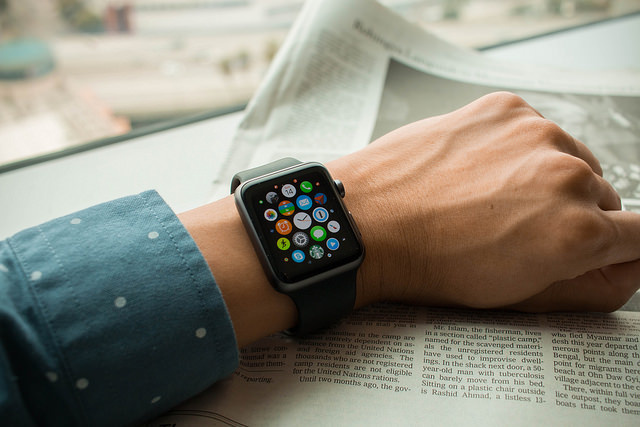
As a solution, the Light Phone reminds me of something I heard recently about the Apple iWatch. The iWatch is the antithesis of the Light Phone–to get data to your iWatch requires that you carry around your iPhone. To me this is too complex and gadgety. In our modern urbanized world, you shouldn’t have to take with you more devices than necessary. To wear something on your wrist that requires something else worn in your pocket to me is more of a capitalist ploy than a user-friendly solution.

apple.iwatch.1-640x427

Well, a couple of colleagues of mine have iWatches–and they love them. They are always the ones at lunches and dinners providing fee demos about the phone’s various functions, which I must add are quite convincing. If I had a thousand bucks burning a hole in my pocket I probably would have bought one already. But the more I hear about the iWatch, the more I am learning about it as a kind of hand-cuff rather than wearable solution. I know one person who came very close to purchasing one but too was held back by the price tag. One day he met up with a colleague who had one that broke.

“Did you enjoy having it?” he asked.

“Oh absolutely–I loved it!”

“So are you going to buy another one then?”

“No.”

“Why not? I thought you just said it was the best thing you had?”

“It was–until I didn’t have it around my wrist. When I had the watch on, I loved the functionality, I couldn’t get enough of it . . .”

“So then what happened?”

“When I could no longer wear it, I felt free! Free from that stupid thing! For whenever I wore the watch, I was looking at my wrist every 3 seconds, all day long! ‘Bling!’ check my wrist. ‘Bling!’ check my wrist. I’m telling you–I feel liberated without that stupid watch!”

But do people feel free when they lose or break their technology? Could you disconnect from your smartphone and/or watch for a day and feel cool about it? Is the Light Phone a fantasy, a utopia, or a serious solution for the 21st Century?

The individual is in a dilemma: either he decides to safeguard his freedom of choice, chooses to use traditional, personal, moral, or empirical means, thereby entering into competition with a power against which there is no efficacious defense and before which he must suffer defeat; or he decides to accept technical necessity, in which case he will himself be the victor, but only by submitting irreparably to technical slavery. In effect he has no freedom of choice.
Jacques Ellul, The Technological Society

This leaves us pondering Jacques Ellul. Technology keeps running amok, and there’s nothing we can do about it. Even when given a choice to have or not have it, we can’t live without it.

jacques ellul
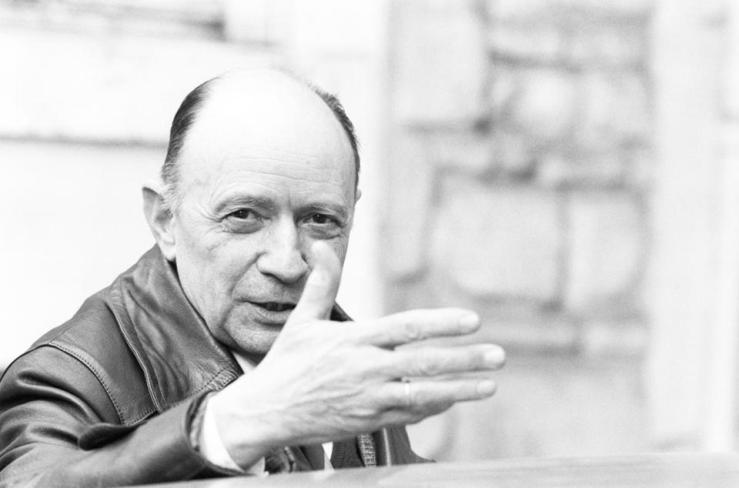
Jacques Ellul predicted the Technological Society would run amok functioning without human intervention.

To me, the Light Phone is a fantasy, a product fetish. It points backward to a time when human life was perhaps simple. It is a fantasy of regress, rather than a solution of progress.

Would I choose a Light Phone? Maybe in another time and place. I like simplicity. I like to think of myself as a simple guy. But I live in a world that demands my time, demands that I am immediately updated and responsive to the information coming at me 24/7. I would like to choose a different life, but that would require that I change what I do. It would require that I enter a simpler life. Perhaps the Light Phone is a symbol of that simpler life, of that utopia (and by the way, ‘utopia’ means ‘no place).

So while I judged the MIT Review columnist for her disdain for the Light Phone, I had three fingers pointing back at me.