The Shock of the Short Now

Ever feel like things are moving too fast? This, according to the book by Douglas Rushkoff, is called “Present Shock: When Everything Happens Now”. This is an important book for engaging in conversations with friends, colleagues, and clients about the fast-lane of the 21st Century. We are being ever pushed around by the technology we create and upgrade to daily. How do we deal with it? Can we slow the pace of our lives down? And what is the price to be paid?

Rushkoff’s analysis is important as a conversation piece; however, I would off-set it with other books, such as Kurzweil’s “The Singularity is Near” and Nicholas Nassim Taleb’s “The Black Swan”, and Stewart Brand’s “Clock of the Long Now”, i.e., books that have a futural perspective, which Rushkoff’s Razor is too quick to cut off in his unflagging and at times myopic focus on the present.

presentshock2

How do you plan in the shock of the short now? How do you ensure that your decisions have a future, are viable, will bring you the success you need? These ideas are important aspects of the work of Kultur Design: helping people and organizations become more creative and innovative while navigating these precarious disruptive times.  In the “Present Shock” of our daily work, we do not take ample time for group learning and building plans and conceptual models of what we’ve learned–we are too reactive and not proactive and predictive. In such cases, as Rushkoff’s book helps us understand, we can be swallowed up by the present, and miss the opportunities and disruptions that lie just a little ways ahead.

More reviews in future posts…
Design is a Synthesizing Act

wilsonquote

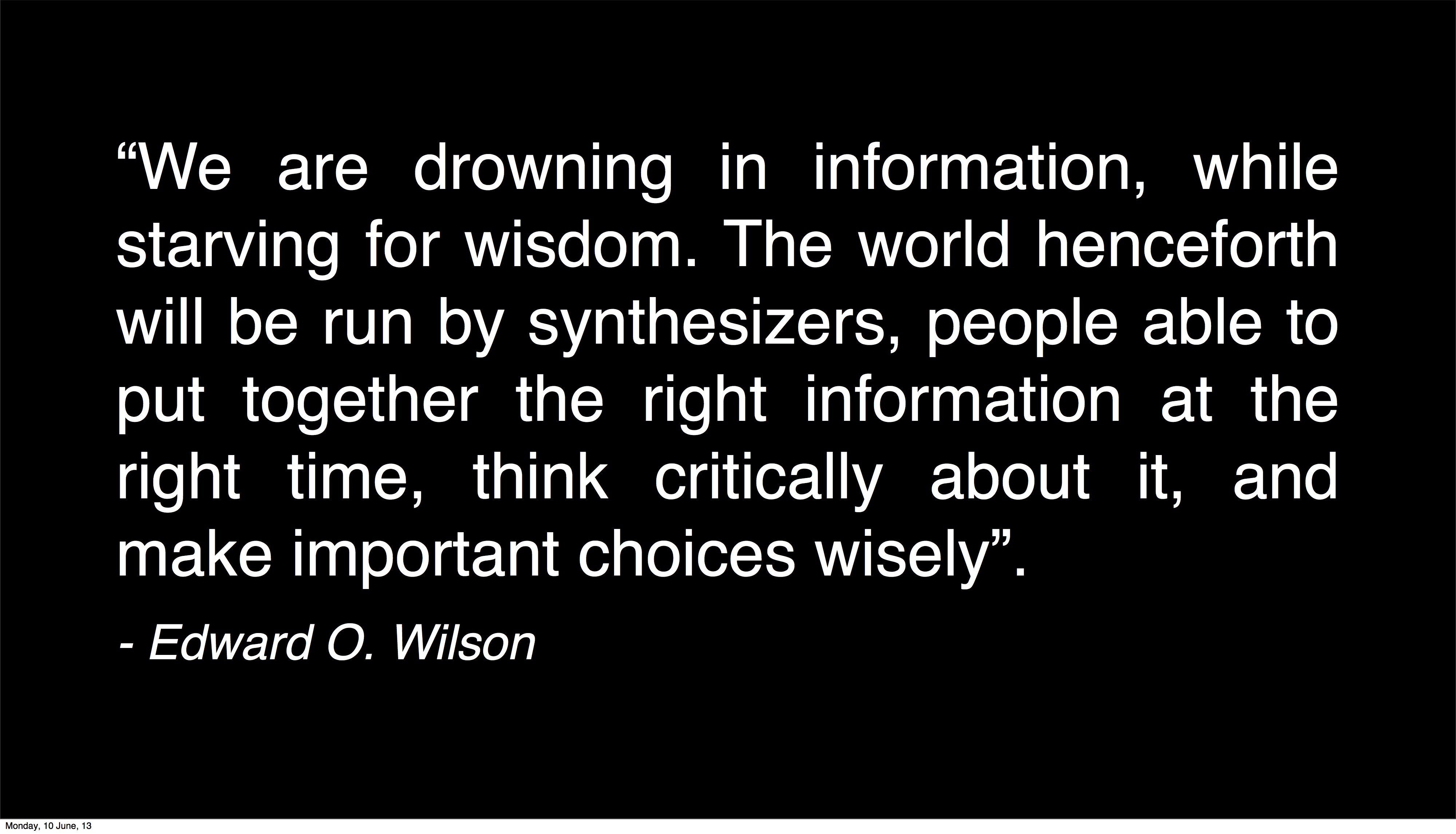
This quote by famous scientist E.O.Wilson speaks so much about the design process, and why it is so important in the Information Age. As Alan Bloom asked, “With all the information in the world where can wisdom be found”. To design is to take existing information and weave it together in new and relevant ways.

When we at Kultur Design work with clients, we use information as a means for finding the right ideas that will create the solution. Often, groups will sit down in the same way with the same ideas expecting a new solution. This will never happen. You need to have diverse information that people are then brought into to wrestle with. The solutions occur when syntheses emerge among ideas and information that seem divergent. And that’s the main challenge that Wilson, as a biologist, sees: that with all the information in the world, we mostly see difference rather than connectivity. Wisdom is then the ability to see everything being connected and able to act with that knowledge in mind in a way that is responsible and intentional. This requires groups of people to see differently, which the design process creates the condition for.

Change & Complexity

Change & Complexity
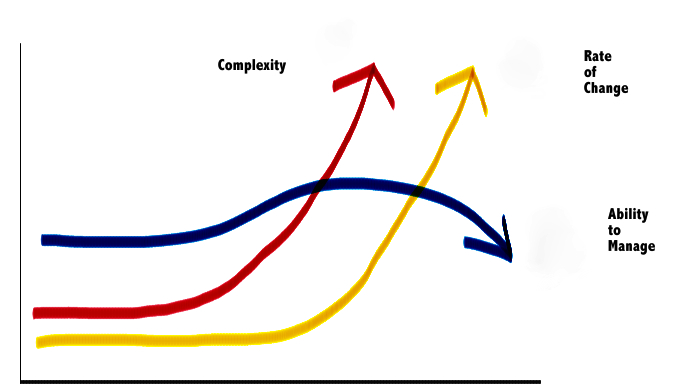
The surging of change and complexity, which overwhelm our ability to manage it through conventional ways of thinking and decision-making. To be on the right side of change requires new ways of thinking and doing: Collaboration, rapid solutions, and innovation.

Collaboration Rapid Solutions Innovation

This is the official blog of Kultur Design, a strategy and innovation company that helps organizations solve complex problems and leverage breakthrough ideas.

We dwell in a rapidly changing and complex world, driven largely by technology. Technology is a system unto itself, under which all of our modern institutions are subsumed and linked together across the globe. This system is a rapidly adaptive and formidably complex one.

This new system places a premium on collaboration:  the bringing together of large(r) groups of people with different ways of seeing the organization and the world, the diversity of which can be leveraged into a requisite solution.

It is often the case that we make decisions only to realize that they were for the Age of Yesterday, rather than what they need to be for: The Age of Tomorrow. This requires the ability to create rapid solutions through prototyping and iteration.

Innovation is the application of creativity to challenges and opportunities. It is a critical antidote to change and complexity. Any organization wishing to be viable in the 21st Century must have a philosophy and culture of innovation.

Why design? Because design is a primary function of our modern world, wether it’s a widget, website, information archive, or city street. Our world is becoming more and more a product of human design. To change our world for the better requires a way of thinking about it and engaging it as a designer would: with intent, creativity, and an eye on the future

This blog is an exploration into this world of rapid change and complexity, created to provide insights and new ways of thinking about the future and how one goes about adapting to it, whether in business or in one’s own creative life.

Why You Need Process Facilitation

It’s 11:00, and you’ve been sitting in the same meeting now for almost 3 hours. Huddled together with your team around the boardroom table, you see that they are disengaging: the energy has dropped out of the room long ago, and you are the only one talking. You need more ideas, but it’s just not happening. You adjourn the meeting at lunch, only to have everyone back within the hour. It’ll take 2 hours for the sleepiness of lunch to wear off, and then it’s almost the end of the day. By meetings end, decisions have had to be made, but you are unsure of their viability. Meanwhile, the world is moving very fast, and so are your competitors. You know you have to be more “innovative”, but you just don’t know how that could be done. You don’t know how to close the complexity gap, or get on the right side of change.

Been there before?

This is common practice. And yet, we all know that it’s highly inefficient and suboptimal. There are countless books and TED Talks about the importance of new ways of thinking, creating, and innovating, and yet, when the meeting begins, for some reason all that good stuff falls through the cracks of the boardroom table, down in the creases of the leather recliners, and somehow miles away from the PowerPoint screen.

Process facilitation is different–it’s all about making meetings easier. Process facilitation is the art of taking groups from vision to strategy to action plans in ways that maximize time, creativity, and collaboration, and minimize distraction, lost information, and poor decision making. Process facilitation is like having a team of waiters at a restaurant preparing the meal and the experience for you, leaving you to do your thing: enjoy your time and the company you’re with. Process facilitation is like having a limo-driver, freeing you up to take calls, make important decisions, and maximize your time without worrying about getting to your destination.

Being in a facilitated creative process significantly amplifies you and your organizations productivity and ability to create and capture new information, and take an idea from concept to prototype to final product in 1/3 to 1/2 of the time of conventional meetings. With a team of people designing and facilitating a customized experience for you and your organization, you are freed up to do what you do best: working on your organization, building it to its fullest potential. Not to mention doing so in a totally creative environment that supports and amplifies your group creativity.

Like Einstein said, the problem is that we are using the same way of thinking to solve problems as what created them in the first place.

It’s time to break out of the boardroom, and into the design studio.

Wanting to know more? Stay plugged in. More on this and other similar topics in future entries…