Holoportation Is The Doorway Into A New World–Seriously.

starwars
Are we becoming less human? 
Sounds like a silly question, but when you look at how technology is developing, the kinds of things being developed, and where it all seems to be going, you get the sense that being human is on the road to obsolescence–without Elon Musk telling us it is so.

One striking example of this is “holoportation”–a terms Microsoft has created for its new hologram solution. As Wired describes,

Holoportation, as the name implies, projects a live hologram of a person into another room, where they can interact with whomever’s present in real time as though they were actually there.

And what inspired holoportation? The amount of time researchers had away from family, and the desire to reach out to them in a more effective way than merely Skype or FaceTime: “We have two young children,” said Izadi, one of the key researchers of the program, “and there was really this sense of not really being able to communicate as effectively as we would have liked,” Izadi says. “Tools such as video conferencing, phone calls, are just not engaging enough for young children. It’s just not the same as physically being there.” The way Microsoft has developed holoportation is to rig up a room with sophisticated 3D cameras that take images of every angle of the individual and the space he or she is in. Once all the images are captured, the custom software stitches them together into a full 3D image. 

Holoportation
Microsoft Holoportation Demo. Can you believe this stuff?!

But get this: to make the technology ubiquitous, Microsoft claimed all one would need is a VR headset. To accomplish this vision, Microsoft has hooked up with Intel to share their knowledge of how to build virtual reality headsets with other VR companies–a way to make this technology ubiquitous. And according to Ray Kurzweil, VR is key to immortality–yes immortality. Through holoportation, one can see how humans will transport themselves all over the world and even to other worlds.

 But there is certainly a difference between encountering a physical person and a hologram. I suppose one could see a technology developed that would trigger sensations in the brain to give one the feeling of being with a physical person while in virtual reality. But, again, is being with a physical person a difference that makes a difference for intimacy and overall human relationship? Is a holographic conversation with my child the same as actually being in the room with him? Is there something important about human connection?  What about when I am sad or hurting? Can a hologram really console me?

This will become ubiquitous, and it will become embedded technology–by that I mean in the brain. This is a doorway to a new world, and we need to be aware of its unintended consequences.

It also presents tremendous opportunity for businesses to design solutions for VR, from business to education. This is the future, and it will very quickly become the present.

7 Striking Reasons Why Your Organization Needs More Designers

designers

There is a surging demand for designers, particularly in Silicon Valley. More Fortune 500 companies are buying design firms than ever before. And designers are being hired by venture capital firms not to design logos, but to take part in the process of finding the best investments.

Why are designers so important? Why should you, if you’re a manager or entrepreneur or business owner seek to hire more designers? Here are a few reasons:

  1. Vision: Design is a process of having a vision for something that doesn’t yet exist and pulling it into reality. Designers have an amazing ability to see new ideas and try them out. Companies today need designers as a response to the world of rapid change and complexity. Organizations today need people who are able to see new ways of doing things, new concepts, new realities, and then be bold enough to try them out.
  2. Iterative: Design is an iterative process. It doesn’t seek to get the solution right the first time, rather it is a process of trying, failing, failing again until the solution emerges. Designers are trained to create a hundred thumbnail sketches for a single concept in only an hour. Their ability to create a concept, scratch it out and create a better one is important in a competitive marketplace that demands a perpetual stream of new ideas and solutions.
  3. Creativity: Designers have an amazing way to think outside the conventional. Whereas engineers like to work in structures, designers will often deconstruct restraining forces before coming to a solution. And contrary to builders who just need the drawings to build, designers know that for the drawings to be inspiring and lead to a user-friendly solution, there needs to be a process of play and trial and error.
  4. Not afraid to fail: Designers are used to failing all the time–it’s part of the iterative process of the work. A designer can recreate and recreate and recreate again. If something doesn’t work and a designer’s work is criticized, no problem: the designer will either keep iterating, or flat-out reject the criticism and continue on. Where ideas and solutions are demanded, you need people with thick creative skin who aren’t afraid to come out of left field and be critiqued for it.
  5. User Experience: Designers are all about user experience and finding solutions to problems. A designer seeks to make a current experience better, easier, more fluid, or to create something new to meet a particular demand. The iPhone came out of Steve Jobs’ disgust at how poor the user experience was for his mobile phone. People want products that respect them; that make it easy for them to use. Designers know how to do this.
  6. The world is designed: The modern world contains more human design than any other time in history. In fact, design makes designers of us all. To design means ‘to mark out’, which makes designers of all of us (Drink a bottled water to see what I mean). And because of this, you need people who understand the language of design and how to create things that stand out from the rest of the designed world.
  7. Integrators: Design is often an integrative art. A good designer can integrate a variety of styles and solutions and concepts into a single solution. Take Frank Lloyd Wright’s architecture: it was often a fusion of different styles and cultural expressions (Japan meets Bauhaus), but that’s what made his houses so rich and textured. In a fragmented world, you need designers who can integrate seemingly disconnected ideas and frameworks into an integrated whole.

10 Strange And Wonderful Things That Happen When You Stay Up Late At Night.

midnight-in-paris-007

I was a night-owl for many years–loved it. But with kids and projects and all the daytime and nighttime responsibilities, I no longer have the luxury of staying up till 3AM. So, over a period of about a month, I transformed from a night owl to early bird, rising between 5:00 and 5:30 to work on things for which I need plenty of time and (quiet) space.

Sometimes, especially on weekends, the night owl emerges, and I find myself up way past my bedtime with the house still and the sounds of exhales from the rest of my household in slumber. There’s something beautiful about the nighttime silence–something that gets my creativity going. Here are some things I (still) love about being a night owl:

1. It’s quiet: When you’re up past midnight, it’s likely you’re alone and the rest of the family is in bed. It’s peaceful. One can get a lot of thinking done with such peace and quiet. It’s one of the only times of day when one can get some real deep thinking and creating done–all that beautiful quiet. The best is not to try to fill it with anything; but if you’re inclined to fill it, to me there’s nothing like a late night jazz radio show–the sound of the city is what I call it. There’s also the late-night radio shows about bizarre phenomena, things that are too uncanny to listen to and take seriously during the light of day. But I’ll just stick with the quiet.

2. Nurturing: This might be a cheezy way of putting it, but there’s a way in which the night has a cozy factor–it’s a time when blankets can be placed over you while you’re huddled over a book, TV or computer screen. This kind of coziness is a by-product of peace and quiet. To me, there’s nothing like putting this coziness in tension with a thriller novel or spy movie. One of the best moments like this was reading Joseph Conrad’s classic ‘Heart of Darkness’ while under the covers at 1AM–something about drifting along the river of the Congo on some strange voyage while also being nurtured by the warm duvet of bed.

3. Productivity: As mentioned, you can get a lot done when there’s no one to bother you. As well, the darkness of night provides a frame of deep focus–you’re not distracted by salubrious sunbeams or frolicking squirrels across your roof, or bird songs out your window. You’re in flow. The night can bring on flow, real flow. There’s no other sound but the tapping of your computer keys or the scratch of your pen or pencil along the notebook. There’s a reason why many creatives love to create at night.

4. Nowhere to go: You have nothing scheduled at this time–it’s time out of (scheduled/arranged) time. As such, you can relax, be in the moment, think, do. This is an important thing, for many of us use schedules and meetings and busy-ness to distract us from our creative work–what Steven Pressfield calls ‘resistance’. This resistance is a killer of creativity, which is why, again, a lot can get done after hours.

5. Stretch the day out: If you feel you don’t have enough hours in the day, usurp your usual 10PM bedtime for 1:30AM. There is indeed a sense that night owls have that the day is something whose every droplet one must squeeze and drain out. This is a way to truly seize the day. Need to stretch it out even more, pull a full all-nighter then get dressed, quaff down a quad espresso and head back out to work. You’ll notice that you won’t be that tired, and in fact you’ll be in a heightened state of awareness.

6. Sleep is better: When you hit the hay after a late-night work session, and you’re head feels like it’s going to split open, and your heart is beating heavy, the bed just feels that much better. Sleep after a time of creative productivity is sweet indeed.

7. New ideas: There is something strange that happens when you’re up late–you have different kinds of insights. It’s like the profound fatigue you’re feeling opens up another dimension of thinking. Many of us are too into our routines and schedule and obligations to engage in deep creative thinking. But when you’re up late and wandering around your place while everyone else is sleeping, your mind takes all that it was filled with over the course of the day and starts amalgamating it together–similar to what happens in dreams. It’s pulling yourself outside of your day that the ideas start to congeal. This is the zone of insight.

8. Sleep in: Night owls tend to sleep in more, which creates the conditions for fresher ideas. There’s something about lying around in bed that gets the brain moving and conjoining all kinds of disjointed thoughts. I find laying around an extra hour in bed in the morning to be very productive–if I have a notebook near by. And that’s the key: keep a notebook handy to jot everything down in. Your phone or tablet’s not good enough–you need a notebook and pen or pencil; for there’s something important about the kinetic act of writing than simply tapping on a piece of glass that gives you greater insight.

9. Be in good company: By becoming a night owl, you can join the ranks of Charles Darwin, Winston Churchill, and yes even Keith Richards. There is an entire history of night owls–those who have plumbed the depths of night to emerge with great jewels of creativity and imagination.

10. Noctambulism: If you want to read something interesting about night owls, read about Charles Dickens’s night walks, or those of William Blake and other noctambulists. There is indeed an art to walking at night, and there are many artists and creatives who relished their times wandering the streets at night: the city lights, the late-night cafes and bookshops, the theatres–the energy of it all. At least on one occasion, Dickens was known to have walked the entire night–a feat that left him energized yet exhausted.

Secrets to powerful meetings top CEOs don’t want you to know

design_meeting_team.jpg

Meetings are at times necessary; some, however, are just plain time-wasters. Sometimes I wonder if workplaces exist to hold meetings–really long ones with plenty of sweet carbohydrates and coffee. If a meeting is necessary, these few tips will help you make the most of it–especially if it’s with 3 or more people.

I’ve worked with Fortune 500 CEOs and global think tanks. Here are some secrets I picked up along the way:

1. Read up: What do you need your team to know ahead of time? Rather than brief them on it in the meeting, send it to them as read-ahead material. This can be anything: documents, articles, news headlines–whatever will be pertinent to the meeting, have your team read it before-hand.

2. Rules of the game: Every game has a set of rules–meetings should too. If you want honest work, you have to create the space for honesty. One rule you can have is ‘whatever is talked about in the meeting stays in the meeting.’ Or, there’ll be no recourse for honesty. You want to have your team candidly, but respectfully, giving their input. This requires very clear rules and boundaries.

3. Get a facilitator: If you’re working through some really complex issues, consider having a paid facilitator to serve as an objective voice and ‘referee’ as it were. Often a leader has blinders on that block him/her from seeing the issue objectively. As well, if there are team dynamics that create barriers to a solution, a facilitator can provide a way through that.

4. Document: How often do you leave a meeting and you have little to no record of what was actually talked about? Don’t rely only on your team to take notes; have someone either in the meeting or an outsider be a documenter. You may also want to consider having different levels of documentation, such as video recording, audio recording, minutes taking, etc. If you use whiteboards, make sure someone is responsible for taking pictures of everything.

5. Environment: The location of your meeting will either help our hinder its outcome. Working in a cramped room with low-ceilings and blinding fluorescent lighting will attenuate your outcome. What kind of meeting is it? If it’s a long meeting, consider working in a space in which furniture can be moved around. If you’re in a boardroom and the table can be moved, push it against a wall and use it as a serving table for refreshments. Get large sheets of paper up on the walls and work standing up. Get music in the background that will enhance creative flow, such as baroque. Get bricolage, legos, and other such building materials in the space to get people working kinaesthetically on solving a problem, rather than just in 1-dimension. Make sure there’s plenty of natural light and a variety of plants.

6. Healthy food: If you must have a lunch meeting over several hours, DO NOT serve complex carbohydrates such as pizza, lasagna, spaghetti, large sandwiches, etc–you and your team will be sleepwalking through the afternoon, no matter how much coffee you’ve had. Instead, you want simple proteins–beef, chicken, or fish–and plenty of greens and other vegetables, sprouts, nuts and seeds. This food will give you the energy you need without the glutted belly and drowsiness that come from carbs. And yes, have plenty of coffee and water on hand–tea as well.

7. Divergence: Meetings are often counter-productive when people are using the same thinking to solve a problem that created it in the first place. Too often, people draw on the same ideas and experiences while trying to create something new. To break this habit, you need to get new information in the meeting space, such as books, articles, magazines, and periodicals. Cultural etiquette for meetings is typically that reading during a meeting is rude. Trash this antiquated rule and give your team plenty to read–and give them material totally outside the issue at hand. I’ve worked with many teams that came up with great ideas on medical solutions after reading books on architecture and sea-creatures. It’s called the power of divergent thinking. By introducing divergent ideas and frames of thinking to a problem, the brain is making new connections which produce new ideas.

8. Design: A meeting can stretch on for hours with little result. You need to have a plan–not an agenda, but a plan. A good rule of thumb is to get people working on stuff to report out after a set period of time. Synthesize the ideas, then break out again. If you have 10 people, have two different teams working on stuff. If you have 3-5, break out individually to tackle a different side of a problem and come back to report after a set period of time. Break up the time of your meeting into stages or frames that deal with a different part of the problem.

9. High to low and low to high: You want to work broadly then into greater granularity; by this I mean, if you’re working on a problem, look at the broader social, economic, political, technological issues of the problem. Then, look at how those global issues are impacting your industry; and from your industry, look at your company. From your company, work your way down into your particular department. When you work on your solution, work bottom up from your department to your company to your industry to the world.

10. Cascade: You should think of meetings as cascading from one another. Work on big meta-issues and lower into granular ones; from a large-scale vision to individual tasks. Take the documentation of the last meeting and use it to create the next meeting, that way your solutions will build on each other. Don’t think of one meeting; think of several over the next month that build on each other.

11. Diversity: Don’t think just your department, but where you can invite others from different parts of the company to give you a better vantage point. Consider also having people join the meeting from other companies or industries to help give you a different view of the issue. Invite someone who knows nothing about your area of work or your company’s solutions to sit in and offer feedback, especially from a customer perspective. For new ideas, you want diversity coming from everywhere–even a competitor.

You will need to think differently about meetings. The standard sit-down and have one person talking all the time doesn’t work. You need to think about how you’re going to get new ideas from everyone, and how you’re going to capture those ideas and put them into action plans.

Having a team of facilitators and designers is important–it takes the work load off you, freeing you up to think and create. Consider this analogy: having an expert facilitator is like the Prime Minister having a chauffeur. The facilitation team does all the planning and heavy lifting, while you and your staff do what you do best: think about and plan out the next big vision and strategy for your organization.
Ian Goldin: Navigating Our Global Future

“The future is unpredictable”… 

This is one of the most poignant and striking TED Talks you will see–and it’s short: a mere 7 minutes long. Goldin is the Director of the Oxford School of the 21st Century and author of the book, highlighted later here at KulturDesignBlog, “Divided Nations: Why global governance is failing and what we can do about it”.

Watch and ask yourself how this future will impact your business, your industry, and your personal life.

This is the future that Kultur Design can help you navigate and leverage. Visit us at http://www.kulturdesign.ca

Design is a Synthesizing Act

wilsonquote

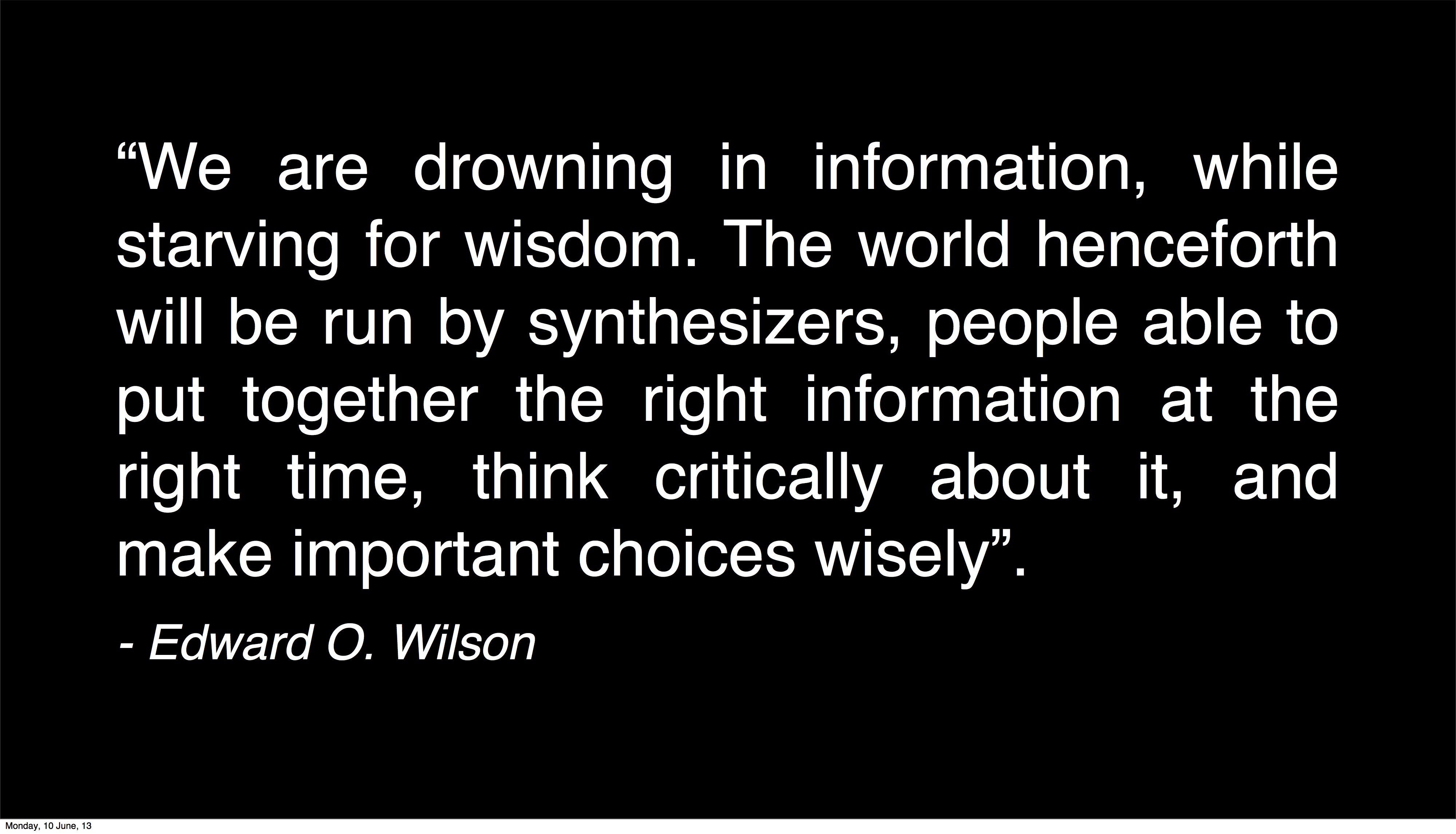
This quote by famous scientist E.O.Wilson speaks so much about the design process, and why it is so important in the Information Age. As Alan Bloom asked, “With all the information in the world where can wisdom be found”. To design is to take existing information and weave it together in new and relevant ways.

When we at Kultur Design work with clients, we use information as a means for finding the right ideas that will create the solution. Often, groups will sit down in the same way with the same ideas expecting a new solution. This will never happen. You need to have diverse information that people are then brought into to wrestle with. The solutions occur when syntheses emerge among ideas and information that seem divergent. And that’s the main challenge that Wilson, as a biologist, sees: that with all the information in the world, we mostly see difference rather than connectivity. Wisdom is then the ability to see everything being connected and able to act with that knowledge in mind in a way that is responsible and intentional. This requires groups of people to see differently, which the design process creates the condition for.

Change & Complexity

Change & Complexity
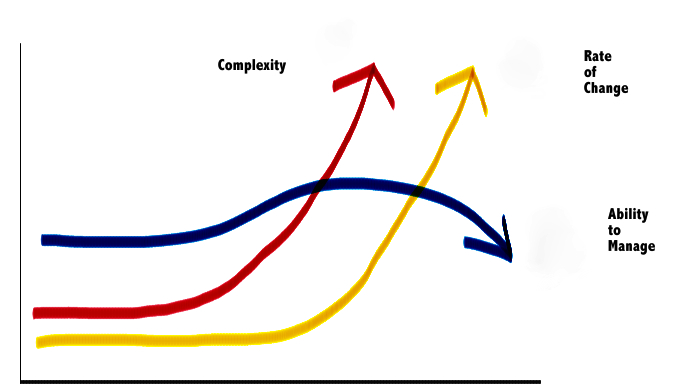
The surging of change and complexity, which overwhelm our ability to manage it through conventional ways of thinking and decision-making. To be on the right side of change requires new ways of thinking and doing: Collaboration, rapid solutions, and innovation.

Collaboration Rapid Solutions Innovation

This is the official blog of Kultur Design, a strategy and innovation company that helps organizations solve complex problems and leverage breakthrough ideas.

We dwell in a rapidly changing and complex world, driven largely by technology. Technology is a system unto itself, under which all of our modern institutions are subsumed and linked together across the globe. This system is a rapidly adaptive and formidably complex one.

This new system places a premium on collaboration:  the bringing together of large(r) groups of people with different ways of seeing the organization and the world, the diversity of which can be leveraged into a requisite solution.

It is often the case that we make decisions only to realize that they were for the Age of Yesterday, rather than what they need to be for: The Age of Tomorrow. This requires the ability to create rapid solutions through prototyping and iteration.

Innovation is the application of creativity to challenges and opportunities. It is a critical antidote to change and complexity. Any organization wishing to be viable in the 21st Century must have a philosophy and culture of innovation.

Why design? Because design is a primary function of our modern world, wether it’s a widget, website, information archive, or city street. Our world is becoming more and more a product of human design. To change our world for the better requires a way of thinking about it and engaging it as a designer would: with intent, creativity, and an eye on the future

This blog is an exploration into this world of rapid change and complexity, created to provide insights and new ways of thinking about the future and how one goes about adapting to it, whether in business or in one’s own creative life.