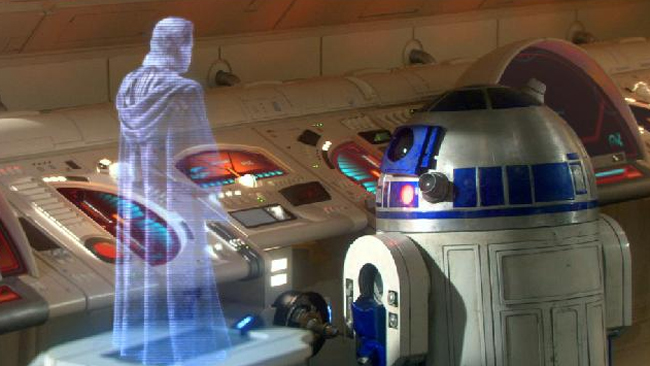
One striking example of this is “holoportation”–a terms Microsoft has created for its new hologram solution. As Wired describes,
Holoportation, as the name implies, projects a live hologram of a person into another room, where they can interact with whomever’s present in real time as though they were actually there.
And what inspired holoportation? The amount of time researchers had away from family, and the desire to reach out to them in a more effective way than merely Skype or FaceTime: “We have two young children,” said Izadi, one of the key researchers of the program, “and there was really this sense of not really being able to communicate as effectively as we would have liked,” Izadi says. “Tools such as video conferencing, phone calls, are just not engaging enough for young children. It’s just not the same as physically being there.” The way Microsoft has developed holoportation is to rig up a room with sophisticated 3D cameras that take images of every angle of the individual and the space he or she is in. Once all the images are captured, the custom software stitches them together into a full 3D image.

But get this: to make the technology ubiquitous, Microsoft claimed all one would need is a VR headset. To accomplish this vision, Microsoft has hooked up with Intel to share their knowledge of how to build virtual reality headsets with other VR companies–a way to make this technology ubiquitous. And according to Ray Kurzweil, VR is key to immortality–yes immortality. Through holoportation, one can see how humans will transport themselves all over the world and even to other worlds.
But there is certainly a difference between encountering a physical person and a hologram. I suppose one could see a technology developed that would trigger sensations in the brain to give one the feeling of being with a physical person while in virtual reality. But, again, is being with a physical person a difference that makes a difference for intimacy and overall human relationship? Is a holographic conversation with my child the same as actually being in the room with him? Is there something important about human connection? What about when I am sad or hurting? Can a hologram really console me?
This will become ubiquitous, and it will become embedded technology–by that I mean in the brain. This is a doorway to a new world, and we need to be aware of its unintended consequences.
It also presents tremendous opportunity for businesses to design solutions for VR, from business to education. This is the future, and it will very quickly become the present.

 Kultur Design Blog